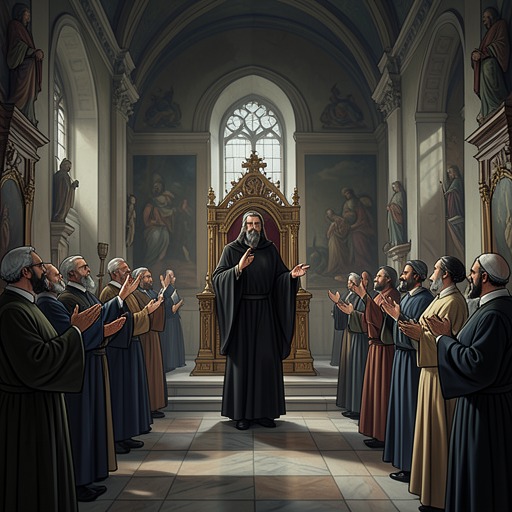
Cao Fang
The Romance of the Three KingdomsCao Fang’s brief rule shows how little authority an emperor could retain when powerful regents controlled the court and its armed force. Appointed to share the care of the young ruler, Sima Yi initially stood beside Cao Shuang; after Cao Shuang took power and sidelined the emperor, Cao Fang’s attempt to rally loyal supporters was exposed, and Sima Shi replaced him on the throne.
Accession and Regency
Cao Fang was eight when Cao Rui, dying after thirteen years as emperor, named Cao Shuang regent and summoned Sima Yi to share responsibility for the child. Cao Rui brought his son to the bedside and told him to trust the two men. Cao Fang clung to his father as he wept; the succession began in a scene of intimate dependence, but the guardians entrusted with the child’s rule would soon contend for control of the state.
Cao Shuang gradually appropriated imperial power. He installed his own associates in senior posts, built palaces, took women from the imperial palace, and removed Sima Yi’s command of the military. Sima Yi withdrew from public life, feigning illness, while his sons also disappeared from view. For ten years, Cao Fang remained emperor in title as Cao Shuang’s influence expanded and Sima Yi waited beyond the visible court.
The Blood-Written Appeal
With almost all his own officers taken from him, Cao Fang relied on three remaining loyalists: Zhang Qi, father of Empress Zhang; Xiahou Xuan, whose uncle had fled to Shu; and Li Feng. Together, they planned to summon loyal men and overthrow both Sima brothers. The emperor removed his dragon-phoenix shirt and cut his finger to write the appeal in blood, turning an imperial garment into the material record of a conspiracy.
Cao Fang’s own recollection made the danger plain: he noted that Dong Cheng had been killed by his ancestor Cao Cao after a similar conspiracy was discovered. The others dismissed the comparison, believing Cao Cao far more perceptive than Sima Shi. Their confidence proved misplaced. Sima Shi stopped the men after they left the palace, questioned their account that they had been studying the Classics with the emperor, and uncovered the shirt and its message. Cao Fang’s appeal thus failed not in battle but through the discovery of its physical evidence.
Purge and Deposition
Sima Shi executed Zhang Qi, Xiahou Xuan, and Li Feng, along with their entire clans. He then confronted Cao Fang in his quarters, where the bloodstained shirt made denial impossible. Cao Fang admitted his part in the plot. Sima Shi also ordered Empress Zhang taken away and killed because she was Zhang Qi’s daughter; Cao Fang pleaded for mercy, but she was strangled. The sequence left the emperor alive but stripped of both his political allies and his empress.
Sima Shi called a council of ministers and declared Cao Fang unfit to rule. He persuaded the queen mother to arrange the abdication and, with her, selected another member of the Cao family, Cao Mao, as the replacement. Cao Fang had no choice but to surrender the throne. The account dates this forced change of ruler to AD 254; it records no later role for Cao Fang.
The Larger Pattern of Rule
Cao Fang’s downfall belongs to the book’s repeated account of imperial authority eroded from within. Earlier, eunuchs had taken over the Han court after the emperor withdrew into the palace; later, the Wei emperor becomes sidelined as Cao Shuang and Sima Yi struggle over regency. In Cao Fang’s case, the imperial title and the symbolic authority of the dragon-phoenix shirt cannot protect the ruler once his officers and political freedom have been taken away.
The attempted conspiracy also echoes the older Dong Cheng plot against Cao Cao, a parallel Cao Fang himself recognizes. But recollection does not alter the outcome: the earlier conspiracy serves as a warning, while the blood-written shirt makes the present one legible to Sima Shi. Cao Fang’s reign ends not with a transfer of power he controls, but with the regent’s accusation, a family-wide purge, and an abdication imposed in the name of his unfitness.